
Best brush for a Pomeranian: what really works on the undercoat
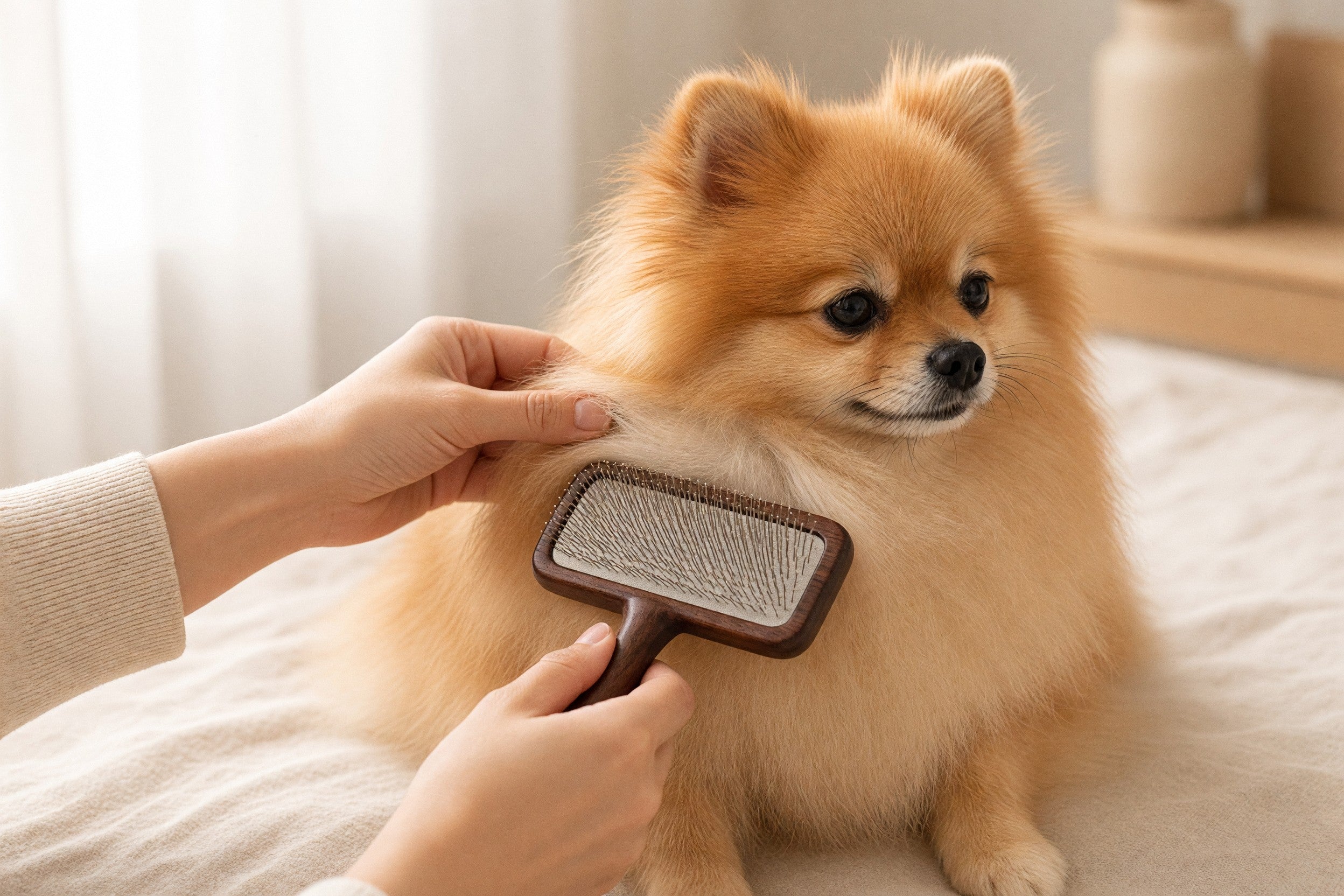
Your Pomeranian looks perfectly brushed, yet the knots keep coming back behind the ears? It's almost never a question of effort. It's a question of brush.
Pomeranians have two coats: a long topcoat, and underneath it an undercoat as dense as wool. Most brushes sold for "long-haired dogs" glide over the first and never reach the second. Here's how to choose one that actually does the job.
The short answer
The one brush a Pomeranian really needs is a slicker brush with a compact head, around 10 to 11 cm (4 in), with fine, closely set metal pins. It's the only brush that reaches the undercoat. Add a dematting rake for shedding season and knots, and a metal comb to check nothing is left. Three tools, no more.
Brushes compared
| Tool | Reaches the undercoat? | What it's for | For a Pomeranian |
|---|---|---|---|
| Slicker brush | Yes | Detangling, removing dead undercoat | Essential |
| Dematting rake | Yes, deep down | Undoing knots, shedding | Very useful |
| Double-sided metal comb | Yes | Final check, small knots | Very useful |
| Pin brush (ball-tipped) | Barely | Finishing the topcoat | Optional |
| Bristle brush | No | Finishing, shine | Optional |
| Grooming glove | No | Surface hair | Not enough on its own |
| Deshedding blade (FURminator type) | Yes | Removing lots of undercoat when shedding | With care |
Choosing a good slicker brush
- A compact head, around 10 to 11 cm. On a 2 to 3 kg dog, a big brush won't fit behind the ears, under the legs or in the trousers, which is exactly where knots form.
- Fine, close, slightly bent pins: they catch dead undercoat without pulling out healthy hair.
- The wrist test: run the brush along the inside of your forearm with light pressure. If it scratches you, it will scratch your dog's skin too.
- A handle that sits well in your hand: you brush section by section, and a session lasts about ten minutes.
The rake and the comb
A dematting rake undoes a knot instead of pulling on it, and lifts out undercoat in bulk when your Pom is shedding. Choose a small one: knots hide in tight spots.
A double-sided comb is the groomer's check. After brushing, run it from the skin to the tips: if it snags anywhere, there's a knot the brush missed. To spot fleas, a flea comb with even closer teeth goes further.
What to avoid
- A glove on its own: dogs love it, but it only picks up surface hair. The dead undercoat stays and mats.
- A bristle brush on its own: great for finishing, useless against knots.
- Deshedding blades used too often: on a double coat, frequent or heavy use can break the topcoat. If you have one, keep it for the peak of the shed and go gently.
For a Pomeranian puppy
A puppy doesn't have its adult double coat yet, but this is the best time to get it used to grooming. A small slicker, used gently for a few minutes with a treat, is enough. Between 4 and 7 months it loses its puppy coat, and that's when the rake earns its place. See Pomeranian shedding.
Our pick
For the method, layer by layer down to the skin, see how to brush a Pomeranian.
Frequently asked questions
Slicker brush or pin brush: what's the difference?
A slicker has fine, bent metal pins packed closely together and reaches the undercoat. A pin brush has wider-spaced pins, usually with ball tips, and is mainly for finishing the topcoat.
Does a Pomeranian need a FURminator?
It isn't essential. A slicker and a rake are enough to handle shedding. A deshedding blade can help now and then at the peak of the shed, as long as you use it rarely and without pressing.
How many brushes do I really need?
Three tools cover all grooming at home: a slicker, a rake and a metal comb. Anything else is a bonus.
How often should I brush?
Twice a week for about ten minutes, and almost every day while your Pom is shedding.