
How to trim a Pomeranian's nails without hurting it
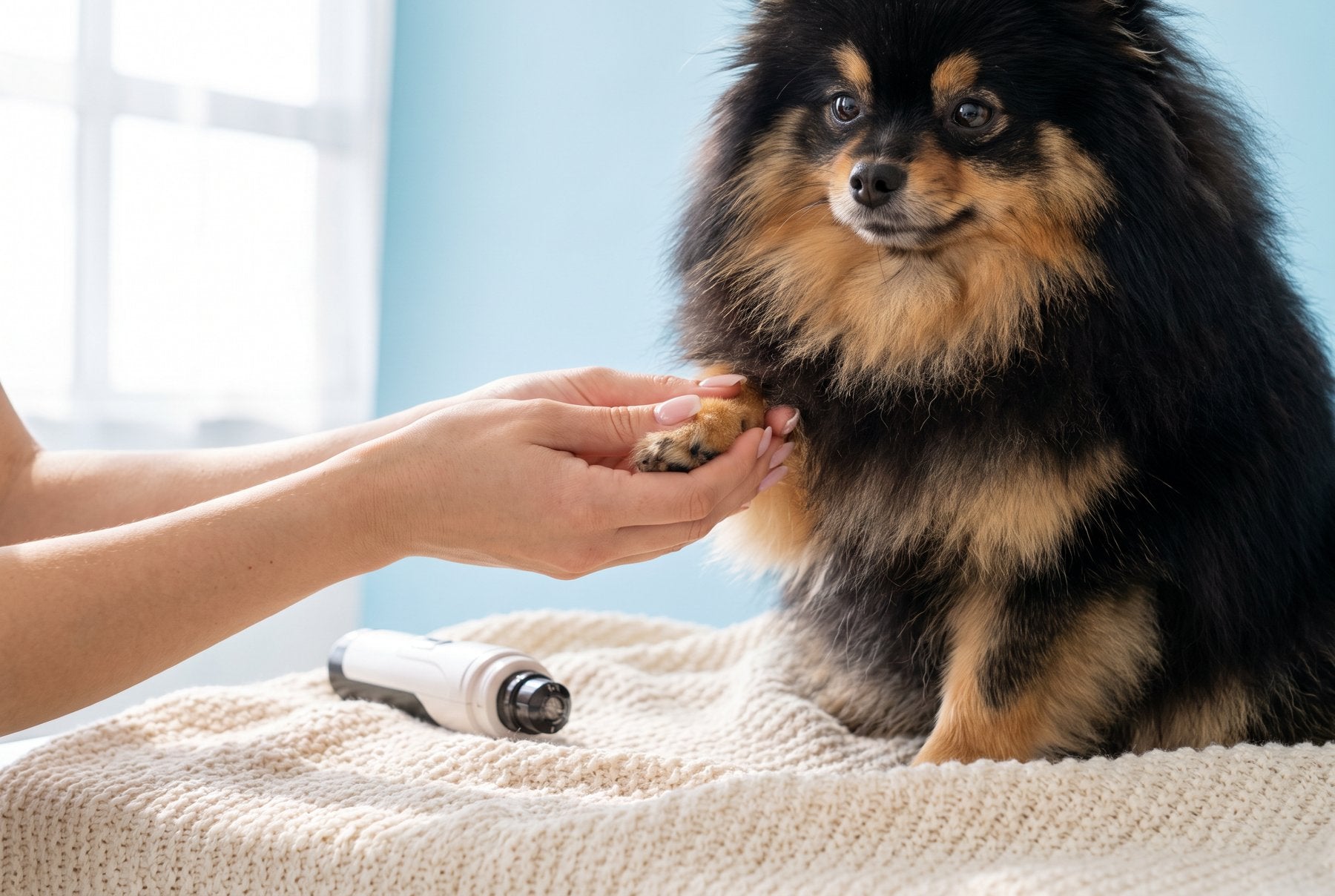
Click, click, click on the tiles: if you can hear your Pom coming, its nails are too long. A small dog that walks mostly on soft floors, and spends time in your arms, doesn't wear them down much. Trimming them scares a lot of owners. With the right method, it becomes a five-minute job.
In short
If you can hear his nails clicking on the floor, they're too long. Trim only the tip, regularly, with a sharp small-dog nail clipper or a grinder. On a light nail, you can see the pink quick. On a black nail, cut in very thin slices and stop as soon as a small dark dot appears in the centre. Keep styptic powder within reach.
Why it matters
A nail that's too long touches the ground with every step. It pushes the toe upwards, changes how the paw lands and can, over time, affect the way the dog walks. It catches on rugs, breaks, and can even curl round into the pad, especially the dewclaw.
For a dog with fragile knees like the Pom, good grip on the ground matters.
Understanding the nail: the quick
Through the centre of each nail runs the quick, a living part with a blood vessel and a nerve. Cut it, and it bleeds and hurts.
- On a light-coloured nail, you can see the quick: it's the pinkish part inside.
- On a black nail, common in black or black and tan Poms, you can't. Trim in very thin slices, and stop when a small dark, moist dot appears in the centre of the cut: it means you're getting close to the quick.
Good news: when nails are trimmed regularly, the quick gradually recedes. Nails that have been long for a while are therefore shortened over several sessions, not in one.
What you need
- Nail clippers for small dogs, scissor-type, nice and sharp. A blunt blade crushes the nail instead of cutting it.
- Or a nail grinder: it files the nail down gradually, which reduces the risk of hitting the quick. Very handy for black nails.
- Styptic powder within reach, in case of bleeding. Failing that, a little cornflour.
- Treats in tiny pieces.
The method, step by step
- Settle it comfortably: on your lap or on a table covered with a non-slip towel, in a well-lit room.
- Clear the hair: on a Pom, the hair on the paws hides everything. Part it, or dampen it slightly to see the nail clearly.
- Hold the paw firmly but gently, pressing lightly on the pad to extend the nail.
- Trim the tip only, staying before the curve of the nail, in small slices.
- With a grinder: a few seconds per nail, touching then lifting off, to avoid heat build-up. Keep the paw hair away from the spinning tip.
- Reward after each nail at first, then after each paw.
Nothing says you have to do them all at once. Two nails today, two tomorrow: that's perfect.
Don't forget the dewclaws
The dewclaw is the little toe set higher up, on the inside of the front leg, sometimes on the back legs too. It never touches the ground, so it never wears down, and it's often the one that grows until it curls.
If it bleeds
Don't panic: it happens even to groomers. Apply styptic powder, pressing on the tip of the nail for a few seconds, and keep your dog calm. If the bleeding hasn't stopped after a few minutes, call your vet. End the session with a treat, and do the other nails another day.
Getting a puppy (or a reluctant adult) used to it
The American Kennel Club suggests a step-by-step approach, one step a day:
- Let it sniff the tool, then reward.
- Lightly touch each paw with the tool, and reward.
- Let it hear the sound of the clippers, or feel the grinder's vibration, against its paw.
- Only then, trim or grind a first nail.
These few days of preparation save you years of struggle. The same principles apply to brushing and a puppy's first weeks.
Frequently asked questions
How often should a Pom's nails be trimmed?
Often every three to four weeks, but it depends on its activity and the surfaces it walks on. The best guide: when its nails click on a hard floor, it's time.
Clippers or grinder?
Clippers are quick and quiet. A grinder is more gradual, more reassuring on black nails, and leaves a smooth edge. Many owners combine the two: clippers for the tip, grinder to finish.
My Pom panics as soon as I touch its paws. What should I do?
Go back a step: handle its paws without any tool, for a few seconds, with a treat. If the fear is strong, ask your vet or a groomer for help.
What about the hair under the paws?
Trim it level with the pads using round-tipped scissors: it makes the dog slip on smooth floors.
Source: American Kennel Club, How to Trim Your Dog's Nails at Home. This article is for information and does not replace your vet's advice.